
President Donald Trump confirmed on Friday that he personally directed the Justice Department to file a lawsuit seeking to block certification of Alaska's U.S. Senate election if Republican incumbent Sen. Dan Sullivan loses. The complaint, filed Thursday in federal court in Alaska, argues that a second candidate named Daniel J. Sullivan on the ballot could confuse voters — an extraordinary step 11 days before the midterm elections.
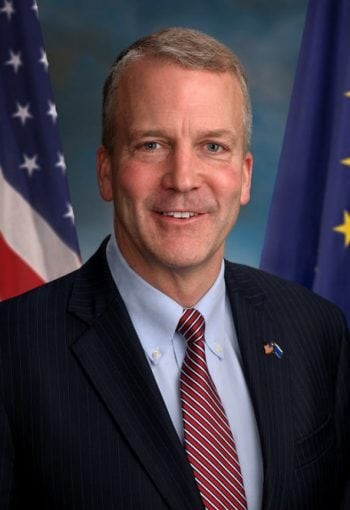
File photo: Sen. Dan Sullivan (R-Alaska). President Trump confirmed he personally directed the Justice Department to sue to block certification of Alaska's Senate race if Sullivan loses.
"I'm the one that said do it," Trump told reporters in Florida on Friday, according to multiple outlets. The Justice Department asked the court to prevent Alaska from finalizing the Senate contest if the votes cast for Daniel J. Sullivan prove large enough to potentially change the outcome of the race between the incumbent and Democratic challenger Mary Peltola.
What the Lawsuit Says
The Justice Department's filing in the U.S. District Court for the District of Alaska asks a judge to declare that "any result that may be impacted by voter confusion" would violate Alaska's duties under the National Voter Registration Act's mandate to "protect the integrity of the electoral process," according to USA Today.
The complaint alleges that "Daniel J. Sullivan decided to run for Senator in 2026 as a Republican with the intention of misleading supporters of Senator Sullivan into voting for him," and that "the sole purpose of his candidacy is to benefit the Peltola campaign," the Wall Street Journal reported. It asks the court to stop the state from certifying the results "pending an investigation to determine whether votes cast for Daniel J. Sullivan were meant to be cast for Senator Sullivan."
The department pointed to several details: the lawsuit contends that Daniel J. Sullivan is "a known longtime supporter of Democratic candidates," that his campaign website "uses a format, color scheme and overall theme similar to the public website for Senator Sullivan's campaign," and that he changed his voter registration between the primary and general elections and is running as unaffiliated with a party. Alaska elections director Carol Beecher determined on June 15 that the challenger had not declared a "good-faith candidacy" but instead "filed with a purpose to confuse or mislead" voters, USA Today reported.
"They Have Two Guys Named Dan Sullivan Running"
Trump has complained about the second Sullivan's presence on the ballot for weeks. Earlier this week he wrote on social media that his administration was examining "powerful legal options" to get Daniel J. Sullivan off the ballot, saying he was "very concerned" that the similar names could be "totally confusing," the Journal reported.
On Friday he went further. "They have two guys named Dan Sullivan running. So the Democrats put up a guy — never, I don't think he ever voted before — all of a sudden he decides to run for the Senate. And his name is Dan Sullivan," Trump told reporters. He accused Daniel J. Sullivan of being a Democratic plant and added: "He has nothing to do with politics. It's a disgrace."
Republicans have taken to calling the challenger "Decoy Dan," according to the Washington Examiner. The Justice Department, in a statement, noted that Alaska's election officials — who are Republicans — had determined the second Sullivan's campaign was an attempt to "mislead" voters.
A Race That Could Decide the Senate
The lawsuit lands in one of the most closely watched contests in the country. Republicans hold a 53-47 Senate majority, and Democrats need to net four seats on Nov. 3 to flip the chamber, CNN reported. Alaska is one of at least 10 battleground states that could determine control of the Senate, according to the Journal.
Polling shows the race too close to call — USA Today cited a RealClearPolitics average with the contest between the incumbent and Peltola, a former U.S. representative, effectively tied. The Wall Street Journal described the race as "extremely close." Sen. Sullivan, who has held the seat since 2015, has drawn sustained national attention as both parties pour resources into a state that has not always been the center of the Senate map.
Trump's Florida rally on Friday underscored how seriously Republicans are taking the threat, with national figures on both sides treating House and Senate contests in the state as unexpectedly competitive.
Courts Already Rejected a Removal Bid
The Justice Department's preemptive certification challenge follows an earlier, failed Republican effort in state court to keep the challenger off the ballot entirely. The Alaska Supreme Court rejected that push, keeping Daniel J. Sullivan on the ballot, according to TANTV.
A state court had previously ruled against removing him as well — meaning the federal lawsuit now seeks to accomplish before the votes are counted what state judges declined to do, shifting the question from ballot access to whether the results themselves can stand.
The Justice Department argued that if Alaska certifies any electoral results "tainted" by the similarly named challenger's inclusion, the state and its officers will have failed in their obligation to protect the integrity of the election, the Journal reported.
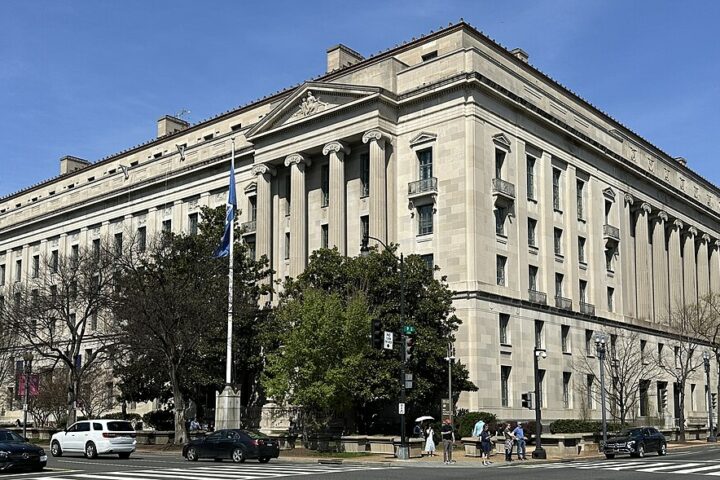
The U.S. Department of Justice headquarters in Washington. The department filed the Alaska lawsuit in federal court on Thursday.
Legal Experts Call the Theory "Absurdly Thin"
Election-law specialists were openly skeptical of the lawsuit's chances. Derek Muller, a law professor at Notre Dame Law School, called the legal claim "absurdly thin" and suggested it was "designed to win the press release rather than the litigation."
"The statute simply doesn't let the Department of Justice enjoin certification," Muller told TANTV.
Speaking to USA Today, Muller added: "I've never heard of it. I've never heard of an election where you try to block certification before the election." Federal appeals courts ordinarily review cases only after a district judge has ruled; here, the Justice Department is asking a court to act on results that do not yet exist.
CNN described the lawsuit as the latest attempt by the Trump Justice Department to insert itself in the administration of elections, running up against the minimal role the Constitution gives the executive branch in running state elections.
Political Fallout Along Party Lines
Reaction split sharply along party lines. "DOJ arguing that Republicans in Alaska are too dumb to understand the word incumbent on the ballot. Geez," former Sen. Claire McCaskill, a Democrat from Missouri, wrote in a social media post.
Mike Davis, head of the conservative legal group Article 3 Project, took the opposite view, accusing Democrats of running a fringe candidate to knock out the incumbent.
The suit also feeds into a broader pattern of Justice Department involvement in election disputes this cycle. CNN noted the department has been pressing legal claims in election administration matters — terrain where, constitutionally, the federal executive branch has historically played only a minimal role.
What This Means
Whether or not a judge ever rules on the merits, the lawsuit itself marks a significant moment: a sitting president publicly directing his Justice Department to prepare a legal challenge to an election result before a single vote has been counted.
If Alaska's race comes down to a narrow margin, the case could become a live test of how far the federal government can go in seeking to delay a state's certification of its own election. And with the Senate majority on the line, both parties are watching closely.
The legal bar for blocking certification is high, and election experts say courts are unlikely to embrace the department's theory. But the political message — that the administration is willing to contest close results — has already been delivered.

Anchorage, Alaska. The state's U.S. Senate race is one of the closest contests of the 2026 midterms.
What Happens Next
The department asked the federal court in Alaska to act before certification, which normally follows the Nov. 3 election by days or weeks. The challenger Daniel J. Sullivan has said he decided to run because he was unimpressed with the incumbent's leadership — a claim Republicans dismiss.
Election Day is Nov. 3. If Sen. Sullivan wins outright, the lawsuit likely becomes moot. If he loses narrowly — by fewer votes than the second Sullivan collects — expect the Justice Department to press for the investigation and certification delay it has requested, and expect an immediate fight in court over whether a judge can even grant that relief.
Either way, the Alaska contest now stands as one of the defining races of the 2026 midterms — and a test case for the limits of federal power over elections.
Post a Comment